-
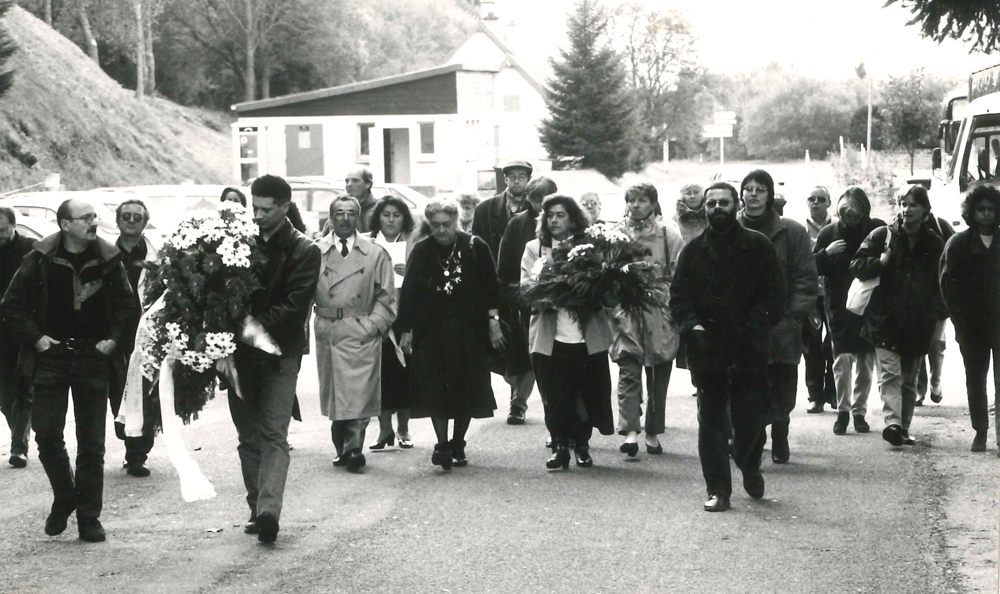
Memorial ceremony at the former concentration camp Natzweiler (© Ilona Lagrene)
CIVIL RIGHTS MOVEMENT IN GERMANY
«Because there were so many swastikas left with you, who knew how to prevent compensation to us, our struggle was in vain»
(Melanie Spitta: Das falsche Wort, 1987).
As the first civil rights organisation of the Sinti and Romani people in Germany after 1945, the “Interessengemeinschaft der rassisch Verfolgten nichtjüdischen Glaubens” (Community of Interest of Racially Persecuted People of Non-Jewish Faith) was founded in 1956. The brothers Oskar and Vinzenz Rose, who had lost many family members in the NS, campaigned for a legal investigation of the genocide. With the help of a private detective, Oskar Rose found and displayed one of the leading heads of racial research at Sinti and Romani people. However, like most other cases against the perpetrators, the prosecution stopped this case. Oskar Rose died in 1968, his brother Vinzenz continued to be involved. In 1974, for example, he erected a memorial at the site of the former Auschwitz-Birkenau camp using his own funds. It is considered the first memorial to commemorate the genocide of Sinti and Romani people.
Meanwhile, Vinzenz Rose founded the “Central Committee of the Sinti of West Germany” together with Romani Rose in 1971, which later became the “Association of German Sinti”. In addition, the Sinti Central Committee was formed at that time. They strove for a nationwide representation of the German Sinti, campaigned against further discrimination and for compensation for Nazi victims. In 1973, the Association of German Sinti organised a large demonstration after an unarmed Sinto, Anton Lehmann, was shot by the police. From 1979 and the cooperation with the organization “Society for Threatened Peoples” , the political efforts of the survivors and the post-war generation received a greater public hearing. They organised several spectacular gatherings: In 1979, on the grounds of the Bergen -Belsen concentration camp memorial, a gathering attended by 2000 people, including many international Romani and Sinti people, representatives of other victim groups and renowned politicians. Together with the international Romani Union, the Society for Threatened Peoples and the Association of German Sinti, a memorandum with important political objectives was handed over to the Federal Chancellery. In 1980, survivors and younger generations went on a one-week hunger strike on Good Friday on the grounds of the concentration camp memorial in Dachau. The civil rights activists demonstrated against the further criminalization of Sinti and Romani people. They demanded an end to the police registration and information on the whereabouts of the files from the rural driver’s offices.
Some of the racial reports from the Nazi era were still in use at Tübingen University. In 1981, 18 Sinti occupied the basement of the Tübingen University Archives and demanded the publication of the files. Finally, the files were transferred to the Federal Archives. In 1982, the Central Council of German Sinti and Roma was founded as the as the federation of 9 national associations. In 1983, Sinti and Romani people demonstrated again against the continuing prevalence of criminalization and registration in front of the Federal Criminal Police Office in Wiesbaden.
After the genocide against the Sinti and Romani was finally politically recognized in 1982, the permanent exhibition on the genocide of Sinti and Romani people was inaugurated 15 years later in 1997 at the Documentation and Cultural Centre of German Sinti and Roma in Heidelberg.
In the 1980s, the work of civil rights activist, publicist and filmmaker Melanie Spitta provided detailed disclosure of the genocide and the situation of Sinti in Germany after 1945. For her filmmaking projects, which she realised together with Katrin Seybold, she researched countless hitherto unknown documents, photographs and events. She represented a feminist position, spoke out on historical persecution and compensation procedures, as well as on current discrimination by social work institutions and in schools. She conducted interviews with survivors and with the younger generation, she allowed many of those affected to speak and was consequently instrumental in documenting the crimes committed against Sinti as well as their living situations after 1945.
After years of struggle by the German civil:rights movement and the commitment of national and international civil rights movements, it was finally possible to inaugurate the Memorial to the Sinti and Roma of Europe who were murdered under National Socialism in 2012.