-
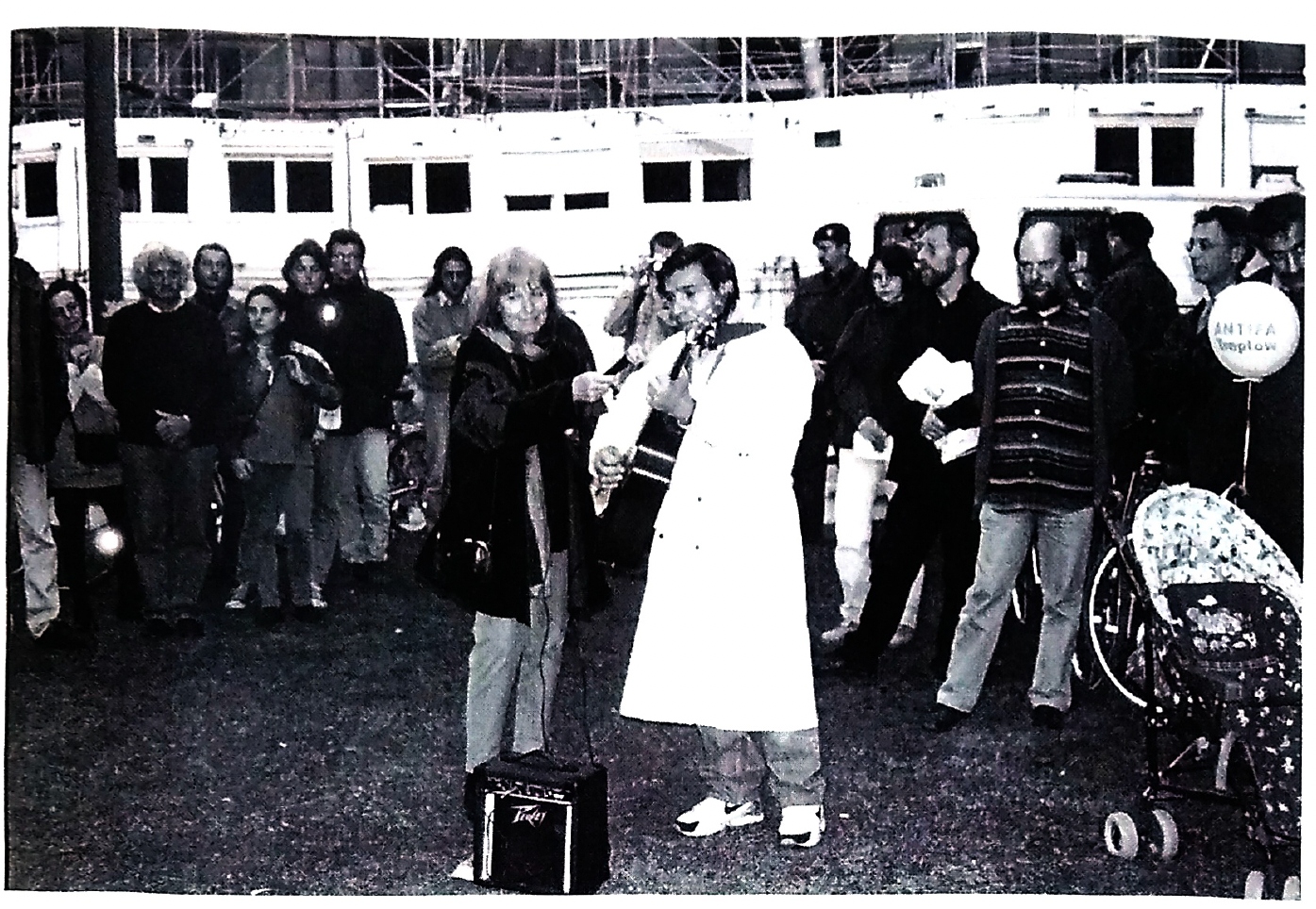
Slobodan Savić sings for a Sinti and Roma memorial Berlin (© Rainer Jaroschek)
Late recognition
In Germany, the racist genocide of Sinti and Romani people was first politically recognized in 1982 by the then incumbent Chancellor Helmut Schmidt. This recognition of the persecution and genocide on racist grounds happened very late, 37 years after the end of the Nazi regime. For the survivors, for their families and for their representatives, this was nevertheless a significant event, which also laid the foundation for a public culture of remembrance.
The central memorial for the Sinti and Roma of Europe murdered under National Socialism in Berlin had to be fought for years despite this political recognition of the genocide by the self-organizations of the Sinti and Romani people and by other organizations and individuals showing solidarity.
Debate about a common memorial of the racially persecuted victim groups
Initially, there was the idea of a common memorial for all groups of victims of the Holocaust. In 1989, Romani Rose, the Central Council of German Sinti and Roma, demanded a common memorial for all racially persecuted victims of the National Socialist genocide. The then chairman of the Central Council of Jews, Ignatz Bubis, did not agree to a joint commemoration. In particular, the Berlin citizens’ initiative Perspektive Berlin, founded in 1988, argued against a joint memorial, citing the singularity of the Shoah. This initial debate over joint or separate commemoration of racially persecuted Nazi victims ended with the decision to erect separate memorials to both groups of victims.
In 1992, the German government decided to erect a separate memorial to the Sinti and Romani poeple of Europe who were murdered under National Socialism.

Debate about the joint homage to the perpetrators and the victims
The proposal of the then incumbent German Chancellor Helmut Kohl to initially combine the memory of all “victims of war and tyranny” in one monument led to further debate. At the Berlin monument Schinkels Neue Wache all persons who lost their lives in the war should be remembered at the same time. This would commemorate Nazi victims as well as SS men who died in the war. The associations of the victims opposed this request to remember and commemorate the criminals and the victims of the racist genocide at the same time.
Debate about the location of the memorial
In 1994, the Berlin Senate proposed the location for the memorial in the vicinity of the Reichstag and the Memorial to the Murdered Jews of Europe, but no further steps were taken to erect the memorial. The publicly promised memorial was not passed because the prepared Senate bill was put away when the new governing parties took office. The CDU had prevented a decision before, in 1995. The next dispute concerned the location of the memorial. The then incumbent mayor of Berlin, Diepgen, wanted to build the memorial on the outskirts of the city in Berlin Marzahn. This was the site of the first forced camp for Sinti and Romani people in Berlin in 1936. He argued against an “accumulation of monuments in the center of the city” his party colleague and then faction leader of the CDU said in the Berliner Zeitung in 1999: “We must still be able to walk through the city with our heads held high.”
As early as 1994, however, the Senator for Building, Nagel, and the Senator for Culture, Ulrich Roloff-Momin, had proposed erecting a monument near the Reichstag. This was confirmed by various politicians, including Federal President Roman Herzog.
The Central Council of German Sinti and Roma and the demand for the erection of the monument/memorial in Berlin Mitte was supported by many prominent figures, including the chairman of the Jewish community in Berlin Andreas Nachama and the historians Wippermann and Benz.
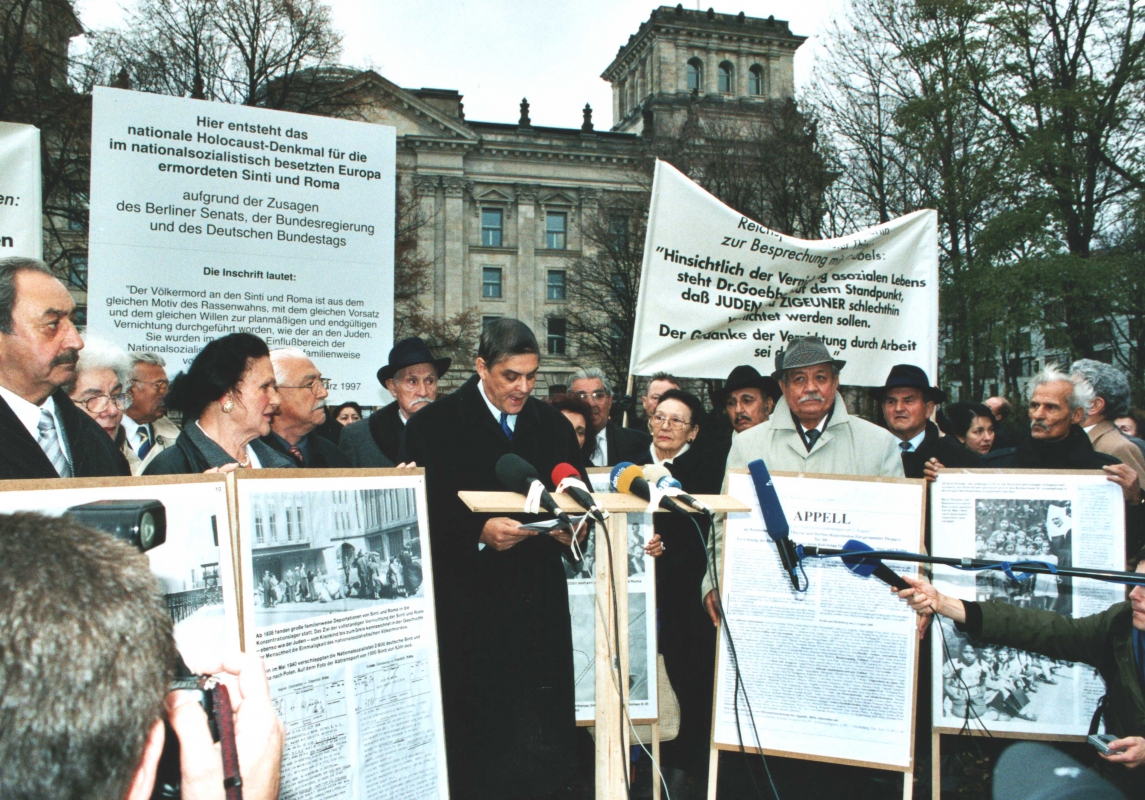
The Sinti and Roma Committee of the League for Human Rights also lobbied for the construction of the memorial and called for annual protests on the site of the planned memorial from 1996 to 1999. The protesters were asked to bring stones to the rally for a symbolic erection of the monument. These demonstrations were received in the press and created political pressure.

In 1999, the Central Council of German Sinti and Roma organized a rally on the site where they put up a sign with the following inscription:
The national Holocaust memorial for the Sinti and Roma murdered in Nazi-occupied Europe is being built here on the basis of commitments made by the Berlin Senate, the German government and the German Bundestag.

Debate about the inscription of the memorial
When the debate about the location of the monument was settled and, after discussions about the artistic design, the architect Dani Karawan was finally commissioned to build it, a new debate began about the inscription of the monument. The Minister of State for Culture and Media, Christina Weiss refused to continue with the decision of her predecessor in office, Nida-Rümelin, and to use a quote from Roman Herzog as the inscription of the monument. Instead, she took into account the concerns of the Sinti Alliance, an association that was just being founded at the time. The Sinti Alliance pleaded for the term Z instead of Sinti and Roma in the inscription. in the inscription. The minister thus placed the concern of a new association on an equal footing with the clear opposition of the long-standing major representative organizations such as the Central Council of German Sinti and Roma, its affiliated state associations, the Cinti and Roma Union Hamburg and Romani Union Berlin.
Thus, the responsibility for an agreement was shifted to the victims’ associations, but the power to decide on the design of the inscription remained with the government. From the beginning, actors who were neither involved in the work of Sinti and Romani people self-organizations nor members of the minority themselves interfered in this debate. After many years of struggle for the establishment of a central memorial, for the location in the Tiergarten, a long and painful debate about the inscription began.
The self-organizations of the Sinti and Romani people, with the exception of the Sinti Alliance, now had to fight to ensure that their murdered people, the Romani and Sinti people, were not commemorated with a degrading designation in perpetrator language. When this debate was also over in December 2007, the Central Council agreed with the German government to use the poem “Auschwitz” by the writer Santino Spinelli as the inscription. In addition, a chronology of Nazi persecution was to be erected at the memorial, in which all groups persecuted under the racist designation would be named. The realization of this concept ended the struggle for the construction of the Memorial to the Sinti and Roma of Europe murdered under National Socialism.